An Introduction to Large Language Models: What You Need to Know
AI has advanced significantly, especially with the development of large language models (LLMs) in recent years. These models, like OpenAI’s GPT-4 and Google’s BERT, are changing the way we use technology. Knowing what LLMs are and how they work is crucial for anyone curious about AI’s future and its use in different industries.
In this blog, we will explore what LLMs are and how they work.
What are Large Language Models?
Large language models are advanced AI systems designed to understand and generate human language. They learn from extensive datasets, which helps them perform tasks like text generation, translation, and summarization with great accuracy. Examples of well-known LLMs include GPT-4 and BERT. GPT-4 excels at generating coherent and relevant text, while BERT has a superior understanding of language context. You can converse with these models, ask them questions, have them write poems, create images, and even translate text.
Types of Large Language Models
Some widely known types of large language models include:
GPT Series (GPT-3, GPT-4)
The GPT series from OpenAI is well-known for its ability to generate text. GPT-3 and GPT-4 can create clear and relevant text that fits the context. They are extensively used in chatbots, content creation, and various other applications.
BERT
Google’s BERT (Bidirectional Encoder Representations from Transformers) aims to understand language context. Unlike GPT, BERT specifically interprets text, making it perfect for tasks such as question-answering and sentiment analysis.
Other LLMs (T5, XLNet)
Other important models in the field are T5 (Text-To-Text Transfer Transformer) and XLNet. T5 handles each NLP task as a text-to-text challenge, whereas XLNet enhances BERT by dynamically considering word contexts.
How Do Large Language Models Work?
Large Language Models such as ChatGPT analyze vast amounts of text to understand language patterns. They function like well-read friends, learning from books, articles, and websites.
If you ask, “What is a cat?” ChatGPT knows it is a small, furry pet that meows, purrs, and hunts mice. These models generate responses based on their learned knowledge.
Using machine learning, LLMs refine their ability to create human-like text. While they lack true comprehension, they excel at recognizing patterns and forming coherent responses.
Neural Networks and Deep Learning
Training LLMs involves using deep learning techniques, especially neural networks. These models analyze large volumes of text data, understanding language nuances by identifying patterns and structures.
The Transformer Architecture
Their architecture uses a transformer to handle long-distance connections and context effectively. Transformers use self-attention to decide how important each word is in a sentence, making it better at understanding and creating text.
Training
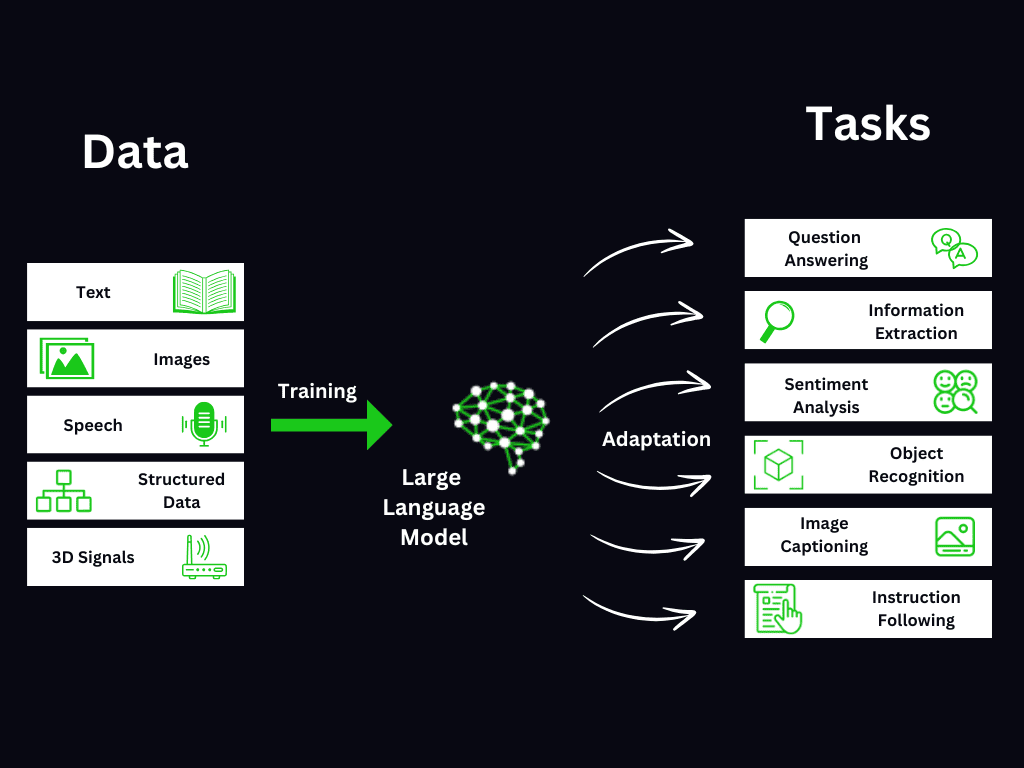
LLMs receive rigorous training using varied and extensive datasets. During this training, they analyze text, grasp grammar, and interpret context. After training, they can be adjusted for specific jobs, boosting their ability in tasks like sentiment analysis and answering questions.
Fine-Tuning
After initially training, developers often fine-tune LLMs on specific datasets relevant to particular tasks. This fine-tuning enhances their accuracy and efficiency in those tasks, making them more versatile and adaptable to various applications.
Benefits of LLMs
Improved Language Understanding
LLMs can perform tasks such as translation, summarization, and question-answering accurately by understanding language context and nuances. This ability makes them valuable tools across various industries.
Versatility in Applications
Large Language Models are very versatile and can be used in many ways. They can automate routine tasks and provide personalized user experiences.
Enhanced Text Generation
They are highly effective at creating human-like text. This makes them perfect for uses such as chatbots, automated content creation, and more. They can generate text that makes sense, stays on topic, and keeps readers interested.
Challenges and Limitations of LLMs
Large language models face several challenges. One big issue is their tendency to generate responses that could be incorrect or biased due to their training data. This can spread misinformation or reinforce biases.
Additionally, these models require a lot of computational resources and energy. This makes them hard for many researchers and organizations to use. There are also privacy concerns because they might store sensitive information from their training data.
Lastly, these models struggle with keeping context and coherence in longer conversations or complex topics. This often results in responses that don’t make sense or aren’t relevant. These challenges show why it’s important to use these models carefully and keep researching to fix these problems.
How to reduce those challenges and limitations?
To tackle large language model challenges, use several strategies. Ensure training data is diverse and representative to reduce bias and improve accuracy. Regularly update and fine tune models with new data to stay relevant and correct errors. Protect sensitive information with strong privacy measures like differential privacy. Optimize algorithms to boost efficiency and reduce resource use. Improve methods for handling context and coherence to enhance response quality. These steps help create more reliable and responsible language models.
Future Trends in Large Language Models
Advances in Model Architecture
Researchers continually develop advanced model architectures to boost efficiency, accuracy, and versatility. Innovations in neural networks and transformer models will drive this progress forward.
Increasing Accessibility and Efficiency
Developers aim to make LLMs more accessible and efficient. These efforts ensure a wider range of businesses and individuals can use them. They also focus on creating lighter models that need fewer resources to operate.
Integration with Other AI Technologies
LLMs now integrate more with other AI technologies, like computer vision and robotics. This integration creates more powerful and comprehensive AI systems, expanding their capabilities and applications.
Conclusion
Large language models are a big leap in artificial intelligence. They offer many benefits and can be used in various industries. These models have challenges, but their potential for innovation and efficiency makes them valuable for businesses. As we develop and improve these models, they will have a greater impact on our daily lives and work. Embrace the future of AI with our expert Large Language Model Development services and stay ahead in the tech race.