How to Implement AI and ML in an Existing App?
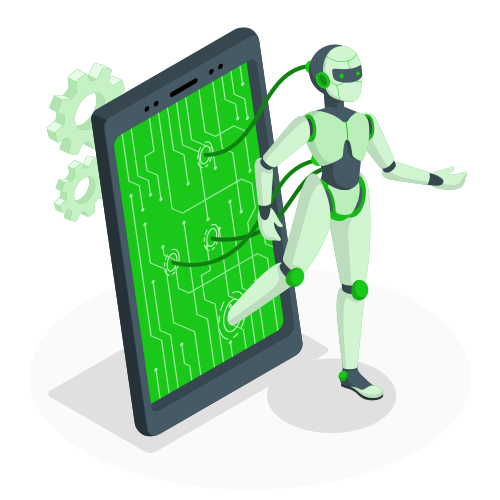
Artificial Intelligence (AI) and Machine Learning (ML) are transforming modern applications, making them smarter, faster, and more efficient. From personalized recommendations to fraud detection and voice assistants, AI-driven features enhance user experience and automate processes.
If you have an existing app, integrating AI/ML can give it a competitive edge by improving engagement, efficiency, and decision-making. But where do you start? In this guide, we'll walk through the best practices, tools, and steps for adding AI/ML to your app.
Wondering how much your project will cost?
Step 1: Identify the Right AI/ML Use Case
Before implementing AI, determine how it can enhance your app’s functionality. Here are some common AI use cases in mobile and web applications:
Chatbots & Virtual Assistants
AI-powered customer support (e.g., ChatGPT-based assistants)
Personalized Recommendations
Netflix-style content suggestions based on user behavior.
Fraud Detection & Security
AI-driven anomaly detection in banking and fintech apps
Image & Speech Recognition
Voice search, facial recognition, OCR scanning
Example:
If you run an e-commerce app, AI can analyze user behavior and suggest products based on past purchases and browsing history.
Step 2: Choose the Right AI/ML Tools & Frameworks
There are two ways to integrate AI into your app:
Using Pre-built AI APIs (Fast & Easy Integration)
- Google Cloud AI (Vision, Speech, Translation, Natural Language)
- IBM Watson AI (Conversational AI, NLP)
- OpenAI API (GPT models) (Text-based AI chatbots & assistants)
Building & Training Your Own AI Model (Advanced Customization)
- TensorFlow & TensorFlow Lite (Great for deep learning & mobile AI)
- PyTorch (Flexible AI model training)
- Google ML Kit (Pre-trained AI models for Android & iOS)
Best Choice?
If you're a beginner, start with AI APIs for quick results. If you need a custom AI model, train your own using TensorFlow or PyTorch.
Step 3: Collect & Prepare Data for AI Training
AI models require quality data to perform well. Here’s how to prepare your data:
Collect Data:
Gather data from user interactions, APIs, databases
Clean & Label Data:
Remove duplicates, structure the data, label categories
Split Data:
80% for training, 20% for testing (to validate AI accuracy)
Example:
A chatbot AI model needs labeled conversations (e.g., “Hello” → Greeting, “Order status?” → Support Request).
Step 4: Train & Test Your AI Model
If using a custom AI model, follow these steps:
Select an AI Algorithm:
Supervised learning (for labeled data) or Unsupervised learning (for pattern detection)
Train the Model:
Use TensorFlow/PyTorch to process large datasets
Test & Evaluate:
Measure accuracy, adjust parameters, improve performance
Example:
For quick implementation, use pre-trained AI models from Google ML Kit or OpenAI API instead of building from scratch.
Step 5: Integrate AI into Your App
There are two ways to add AI to your app:
Option 1: Use AI APIs (Simple & Scalable)
APIs allow you to integrate AI features without training your own models. Some popular APIs:
Google Cloud Vision API (Image analysis, face detection)
OpenAI GPT API (AI chatbots & natural language processing)
IBM Watson AI (AI-powered analytics & predictions)
Option 2: Embed an AI Model (For Offline AI Processing)
For offline AI models, use:
TensorFlow Lite (Android/iOS) – Runs AI models directly on mobile devices
Core ML (Apple) – AI-powered features for iOS apps
Step 6: Optimize Performance & Deploy AI Models
To ensure your AI model runs smoothly and efficiently, follow these optimization techniques:
Model Compression
Reduce the size of AI models using TensorFlow Lite or ONNX
Edge AI Processing
Run AI on-device instead of relying on cloud servers (for speed & privacy)
Cloud Scaling
Use Google Cloud AI or AWS AI for handling large-scale AI requests
Step 7: Maintain & Improve Your AI Features
AI models evolve over time, requiring regular updates. Here’s how to maintain AI performance:
Monitor AI Predictions
Use logging tools like TensorBoard
Retrain Models with New Data
AI improves as more data is fed into it
Check for Biases & Errors
Ensure fairness and avoid biased predictions
Example:
A fraud detection AI must continuously retrain on new fraud patterns to stay effective.
Conclusion: Future-Proof Your App with AI
AI and ML are transforming apps, making them smarter, faster, and more efficient. Whether through personalization, automation, or security, AI can give your app a competitive edge.
Success lies in choosing the right AI tools, optimizing performance, and continuously improving models. Prebuilt APIs offer quick integration, while custom models provide greater flexibility.
AI is no longer optional. By integrating AI today, you’re not just enhancing your app, you’re ensuring it stays relevant and future ready.